A Classical Layman’s First Impression

If you’ve followed my writings about new music, or at least since September, you may remember me mentioning a friend of mine who was going to listen to some new music that I recommended (which I’ve since deleted the references to, as my first plans to do this fell through and the article was going out in a newsletter). This friend had little to no experience with classical music outside of film score (which we both agree with Anne Midgette that it’s a good introduction to classical music), so this would be a step beyond dipping a toe in with some Mozart or Brahms. His name is Alex Wiederspiel, he is the current faculty advisor at our old college radio station, U92, and is also the news director at another radio station in West Virginia. The pieces I assigned him were John Adams’ Absolute Jest, Caroline Shaw’s Partita for 8 Voices, Max Richter’s recomposition of Vivaldi’s The Four Seasons, Jennifer Higdon’s Viola Concerto, and Kevin Puts’ Four Airs. When he finishes them, I will update this post with his written opinions on the works—this will be after his second or third listens to these pieces. We had a talk about his first impressions, and here that is!

Part 1:

Part 2:

Part 3:

At some point, we’ve agreed that I will give him a “level 2” of sorts; some music that isn’t quite as immediately palatable as this list (I’ve played three of these on the radio). If you’ve listened to these works (check your streaming services; they’re all there), what are your first impressions?

First Impression: A New Thing on New Music

Hello everyone! You may have missed my online presence or perhaps expected to see a December Student Composer of the Month. Moving forward, I don’t plan on making my online presence as dedicated to such a specific element of new music, and instead, I have a new… well, it’s not necessarily a blog, as my primary focus won’t be writing at length about new music, and it’s certainly not a podcast, but I don’t like the idea of calling it a list or a schedule, which is essentially what I’ll be providing for happenings in new music, and I think calling it a guide would imply that I have a higher degree of expertise than I really do… let’s just call it a thing for now. The entire purpose of this thing is to disseminate information about new music that goes on either in the Baltimore-Washington area or put on by people associated with the area, in classical music or involving classical musicians. For pieces not receiving their premieres, my limit for what is “new music” is within ten years, which still may be too old for some. I intend to have a new one of these things up around the beginning of each month to talk about what is going on in that month and the following ones, and anytime I receive an update (send me an email at jscherch@www.testwjbcg1440.com), I will update the current month’s post and update our social media platforms accordingly. That all being said, let’s have a look at what’s going on in new music this month!

NEW OPERA

The Prototype Festival in NYC kicks off on Saturday, January 5th, but if you haven’t made your plans to go up yet, you still have planning time to make it to Frances Pollock‘s Stinney: An American Execution, an opera she premiered to critical acclaim at 2640 Space on St. Paul Street while she was still a student at Peabody Conservatory. The New York premiere runs for two performances, on Saturday 1/12 at 5 PM and Sunday 1/13 at 3 PM, both in Florence Gould Hall at French Institute Alliance Française; find more information here.

Also happening in new opera is The Falling and the Rising, an opera with music by Zach Redler and libretto by Jerre Dye. The project was conceived by SFC Ben Hilgert of the U.S. Army Field Band, which rehearses in Fort Meade, and was premiered in April 2018 at Texas Christian Univeristy with the Field Band and students of the TCU School of Music. The next performances will be on January 12th and 13th at the Ailey Citigroup Theatre in NYC, and the opera will be performed by Peabody Chamber Opera at Baltimore Theatre Project February 7-10. More information here.

IN THE STACKS

The In the Stacks series at the George Peabody Library has consistently drawn sellout crowds—the first 200 are admitted and the performances cost an honor-system donation—and they have put on excellent exhibitions of new and recent music. The next concert, In the Stacks: Part 3, features Baltimore’s Bergamot Quartet performing a program that takes its inspiration from the George Peabody Library’s unrivaled collection of ‘fore-edge paintings’—books with secret works of art hidden in the pages.

NEW MUSIC AT ST. DAVID’S

As part of the St. David’s Music Series (which we talk about on-air), baritone Rahzé Cheatham will perform a recital as part of the church’s annual tribute to Martin Luther King, Jr., including some works of his own composition.

In the following months, soprano and Peabody faculty member Ah Young Hong will perform a recital (featuring no new music, but she performs a lot of new music which I encourage checking out), and you’ll also have another chance to see the Bergamot Quartet at St. David’s in March.

SHRIVER HALL BALTIMORE PREMIERES

You may also recall hearing about the Shriver Hall Concert Series on our air; on January 27th at Baltimore Hebrew Congregation, violinist Jennifer Koh and pianist Shai Wosner present the Baltimore premiere of Vijay Iyer’s Bridgetower Fantasy, paired with works of Beethoven including his Kreutzer sonata, originally dedicated to and premiered by George Bridgetower, a famous 18th-century Afro-European violinist, with the composer at the piano (the rededication to Kreutzer followed an argument over what Beethoven construed as Bridgetower’s insult of a female acquaintance).

Also coming up at Shriver Hall on March 24, clarinetist and composer Jörg Widmann performs the Baltimore premiere of his Quintet for Clarinet and Strings with the Hagen Quartet. The artists gave the work’s world premiere in 2017 in Madrid, and will give its U.S. premiere at Carnegie Hall two days prior to its Baltimore performance.

PIQUE COLLECTIVE AT PUPPET SLAMWICH

Baltimore new music ensemble Pique Collective is the musical guest at the Black Cherry Puppet Theater for their January Slamwich—an evening of puppetry and performance geared more towards grown-ups—though all ages are welcome! Show is 1/12, more information here.

PEABODY WIND ENSEMBLE PROGRAMS NEW MUSIC

The Peabody Wind Ensemble‘s upcoming concert on January 26th at 7:30 features a work by Peabody graduate Matthew Pellegrino called Winter Unending, Invincible Summer, along with standard and less-standard wind repertoire. We’re talking about this one on air, and listen for my interview with conductor Harlan D. Parker.

…NOT NEW MUSIC, BUT…

So this particular concert doesn’t feature any new music on it, but the soprano Katie Procell is a singer you should keep your eye on, as she specializes in new and only slightly less new music. On her concert I Have a Song to Sing O! she and her friends, pianist Valerie Hsu, tenor Ricardo Garcia, and bass-baritone Drew Holcombe will perform a free program of Gilbert & Sullivan at First & Franklin Presbyterian Church on February 2nd at 8 PM.

“A TALE OF TWO MARIMBAS”

Part 20 of the Thrive Music Live series will feature Jeff Stern and Matthew Keown, performing a program entirely composed of new music on marimba and drum kit. The show is at 7:00 on Saturday, January 26th at Studio 5N, located at 302 E Federal Street in Baltimore.

NORTH AMERICAN PREMIERE OF ARNOLD SALTZMAN’S HALEVI

The combined forces of the American University Symphony Orchestra, Chorus, and Chamber Singers are joined by the Strathmore Children’s Chorus and guest soloists Janice Meyerson and Baltimore-based baritone Rob McGinness to perform the North American premiere of Arnold Saltzman’s A Choral Symphony: Halevi. Completed in 2017, this large-scale composition is a lush and evocative symphonic setting of English translations of texts by the twelfth century Hebrew poet Judah Halevi. One afternoon only, February 24th at 4:30 PM at The National Presbyterian Church in DC.

OUTCALLS ANNOUNCE NEW SHOWS

Classically infused feminist pop band Outcalls, led by sopranos Melissa Wimbish and Britt Olsen-Ecker, have two shows coming up on February 9th and March 9th. Witness the impressive results when classical musicians start an indie rock band!

BSO PROGRAMS US PREMIERE

I was happy enough when the BSO performed Turangalîla this month; at the end of this month, part of their performance (January 31-February 2) will consist of Helen Grime’s Percussion Concerto, featuring Colin Currie, who premiered the work in London, also under Marin Alsop.

ST. JOHN’S WESTERN RUN PARISH FEATURES ICARUS QUARTET

The St. John’s Western Run Parish Music in the Valley series’ next performance features icarus Quartet, consisting of two pianists and two percussionists, performing works by Paul Lansky, Alex Weiser, Brad Lubman, and a premiere by Michael Laurello. The show is Sunday, February 3 at 5:30.

If I’m missing anything, leave a comment below or send me an email at jscherch@www.testwjbcg1440.com.

Student Composer of the Month – November 2018: Frances Pollock

Welcome to Student Composer of the Month, where we talk with a composer each month that is currently studying or has recently studied in the greater Baltimore area. This month’s composer is Frances Pollock, a graduate in theory and composition from Furman University and in voice from Peabody Conservatory, now studying composition at Yale University. She premiered her first full opera, Stinney, at 2640 Space in Baltimore to critical acclaim and multiple awards; the opera will receive its NYC premiere in January at the Prototype Festival.

Interview coming soon, featuring special guest Alexander Lloyd Blake, who will conduct the NYC premiere of Stinney.

Visit Frances’s website, francespollock.com.

Student Composer of the Month – October 2018: Quinn Dizon

Welcome to Student Composer of the Month, where we talk with a composer each month that is currently studying or has recently studied in the greater Baltimore area. This month’s composer is Quinn Dizon, our first composer not associated with Peabody Conservatory. He has been commissioned by various soloists and large ensembles to write works for a myriad of occasions and special events. He holds degrees in composition and conducting from The College of Wooster and The University of Louisville, and is a current Flagship Fellow at the University of Maryland. He has worked recently as a conductor and a music educator, and is an advocate for the performance of new music.

Part 1:

Part 2:

Part 3:

You can listen along, with or without our commentary on the piece, on this page of Quinn’s website.

Educated and Not-So-Educated Perspectives on New Music

At least one of you has noticed that, contrary to my “mission statement” I posted when I first started working here, I haven’t gotten around to playing a lot of new music on the radio. That’s largely because I remembered that radio is a medium on which you can’t skip past what you don’t like, and unlike a station backed by a steady stream of dollars for educational purposes, we have to think about whether or not people are listening and/or enjoy what’s playing. So I’ll leave that up as a testament to my naïveté. Being out of the game for two years takes a toll!

This is of course not to say that I have lost any of my interest in new music, however, and since this is the internet, where you can skip to the end or skip the thing entirely (though I would enthusiastically recommend against doing so), we’ll be talking about new music, and we’re going to have just an excellent time. We’re going to look at new music through the eyes of active composers and my own far less practiced point of view.

Many of you are likely aware that I did a nearly-monthly podcast last year called Student Composer of the Month, where I would talk with a local or formerly local, usually via academia, composer about pretty much whatever we want. We would generally start with where they came from as a student of music and it would usually spin into discussions of musical philosophy, the state of music in general, and where they see music going in general, with little relation of their own music to what is or is supposed to be happening in music. Tom Hulce’s Mozart from the film Amadeus would be a likely unemployed anomaly today (and is of course at least an exaggeration of the composer himself); you’ll hear no composer refer to their works as “the best music yet written,” and while they have their views on what music is better than others, they’ll never begrudge or scoff at someone for having Mozart as their favorite composer or not understanding new music. A fair amount of it is indeed difficult to grasp and there are some works that might not sound to some people like music at all. Music is now sometimes composed in the classical style for instruments and sounds that are not traditionally found in classical music. That all being said, music is moving back from the hardcore academic and inaccessible music of the mid-20th century, composed as a reaction to the emergence of popular music, into more tonal and accessible realms, though still exploring yet unheard arrangements of sound.

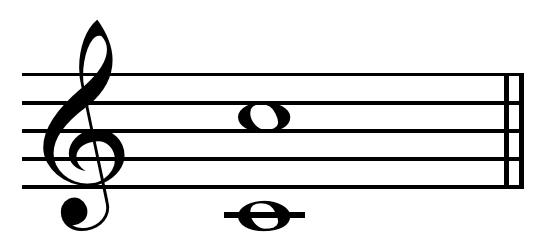
A traditional consonance, the perfect octave.

One word you’ll often hear the composers on my podcast cringe at is “beautiful.” The reason is that the word “beautiful” seems to have a quite narrow definition when it comes to music, and it implies negativity in works whose primary quality is not beauty. Another debated concept is that of consonance; in my undergraduate music history class, I learned about composers in the early twentieth century aiming to use the four “standard dissonant intervals”—that is, seconds, fourths, sevenths, and tritones, as “consonance,” while unisons, thirds, fifths, sixths, and octaves would be seen as “dissonant.” Instead of specifying a definition of “consonance,” today’s composers are expanding the range of sounds that can be heard as “consonant” by contrasting them with an equally wide array of “dissonances.” The rules of what one can do with music are as loose as my explanations of these concepts as they relate to new music—you can create, follow, or break as many of these rules as you’d like, so long as there is a purpose for doing so. Sometimes music is composed for a certain event, or a song set to a certain poem. There are calls for scores that generally ask for shorter works—overtures and the like, intended to provide a sprinkle of new music to accompany orchestras’ larger standard program, which frustrates some composers and new music advocates because while standard repertoire is standard for a reason, it doesn’t make much room for the wide array of composers who don’t have centuries of performance to back up the quality of their music, though the process of composing said music is really not very different from how music has always been composed—the difference is what you’re hearing!

A traditional dissonance, the minor second.

Speaking of what you’re hearing, what I have to provide is perspective as a listener of new music. I am by no means an expert on the subject—just a fan who wants to find out more. As you might know, my broadcasting background is in college radio, where the station’s financial independence afforded its DJs an array of music to play that challenged host and listener alike. Washington Post classical music critic Anne Midgette, in her review of a show I’ve been singing in, related our treatment of standard repertoire (the Verdi Requiem), because of its pairing with a concurrent monologue, to the rawness of when the piece was new, when it was “provocative, unfamiliar, something you might not like.” I’ve always found that unfamiliarity exciting, though I understand, especially in today’s pop-dominated world, that familiarity is one of the main things listeners seek in music these days. The music I would play on the station would take time to acclimate to; it was challenging and sometimes grating, but it was music that I had never heard and wanted to share with listeners, and sometimes they would turn the radio off, but those that stayed got to share in that excitement of discovery. This goes the same for new classical music (which you’ll notice the “grating” link is included in); my interest is that of discovery, of course without ever forgetting what great music came before.

I would like to know, especially from those of you who do not play music yourselves (since most of you likely have a decent amount of experience listening to classical music), what you think of new music. Let’s get a discussion going and then we’ll hear from my old friend. In the meantime, check out these 5-minute clips, many featuring relatively new music, recommended by artists and compiled by the New York Times.

Student Composer of the Month – September 2018: Daniel Sabzghabaei

Welcome to Student Composer of the Month, where we talk with a composer each month that is currently studying or has recently studied in the greater Baltimore area. This month’s composer is Daniel Sabzghabaei, who finished his Master’s at Peabody in 2017 and is currently pursuing his Ph. D. at Cornell University. In this edition, I chatted with Daniel via FaceTime and therefore could not concurrently play music, so the pieces we talk about are linked below, as well as his perspective on Sufism as a composer.

Part 1:

Part 2:

Part 3:

Pieces we talked about (you can listen and read along with the score):

Upon Viewing a Family in Mourning

The Blue Booby

Daniel’s essay, Sufism as a Compositional Impetus

You can listen to more and find out more about Daniel at danielsabzghabaei.com.

Student Composer of the Month – August 2018: A Call for Composers

Hello, friends!

Normally around this time, you’d be seeing a clip on our site featuring a talk with a composer in the Baltimore area who studies or has recently studied in the area, and who also usually has some other interesting things going on in their career. Instead of clamoring to find another composer who’s able to drop by the studio for an hour in time for August 1, I figured it might be nice to remind you of who we’ve talked with so far (all of whom can be found in the Student Composer of the Month tag above), and to let composers and professors of composition know that I am seeking more composers to talk with on this podcast, simply to give a little more visibility to a field that doesn’t always get the attention it deserves. There’s no rigorous process to speak of–all I need is a reference from a teacher or a colleague, and I’d prefer if we could have a recording to play and talk about (minimum MP3 320 quality, preferably lossless i.e. WAV or AIFF). Send me an email at jscherch@www.testwjbcg1440.com if you’d like to come on the podcast!

Student Composer of the Month – July 2018: Peter Dayton

Welcome to Student Composer of the Month, where we talk with a composer each month that is currently studying or has recently studied in the greater Baltimore area. This month’s composer is Peter Dayton, who finished his Master’s at Peabody in 2016, has many published recordings, and continues to consult with various prominent composers regarding his work.

Part 1:

Part 2:

Part 3:

Part 4:

Visit Peter’s website, peterdaytonmusic.com

Student Composer of the Month – June 2018: Steven Crino

Welcome to Student Composer of the Month, where we talk with a composer each month that is currently studying or has recently studied in the greater Baltimore area. This month’s composer is Steven Crino, who recently completed his Master’s and will pursue his doctoral studies at Peabody Conservatory.

Part 1:

Part 2:

Part 3:

Visit Steven’s website, http://www.stevencrino.com/

Student Composer of the Month – May 2018: Elliott Grabill

Welcome to Student Composer of the Month, where we talk with a composer each month that is currently studying or has recently studied in the greater Baltimore area. This month’s composer is Elliott Grabill, a recent graduate of Peabody Conservatory.

Part 1:

Part 2:

Part 3:

Visit Elliott’s website, http://elliottgrabill.com/