Pop socks

If you think that Mark has sounded blue or Dyana has sounded green the past couple of days, it’s not because they are, respectively, sad or sick, it’s that all the WBJC announcers now have individualized multicolored pop socks.  (For the uninitiated, a pop sock is the cover that goes over a microphone to minimize the popping when we speak into the mic.)  Everyone is too polite to say so, but I suspect that it’s all my fault.  The redoubtable GM of WBJC handed out the multicolored pop socks, like handing out candy, shortly after I had that respiratory infection a couple of weeks ago.  So, listen for Reed to sound orange, Kati to sound yellow and Jonathan to sound purple.  As for me?  Well, it seems I’m the traditionalist around here: I’m black.


Getting in on the conversation

With “The Help” picking up four Oscar nominations today, I confess I’m only just catching up with this highly successful phenomenon.  I was certainly not one of those who contributed to its being on the New York Times best seller list for more than 100 weeks!  Having grown up under the egregious apartheid system in South Africa, I didn’t think I had the stomach to read a book so grounded in the racial conflicts of the 1960’s Deep South, much less see the film, and I resisted both for the longest time.  My niece and sister eventually persuaded me to give it a chance, and so I downloaded it from the library onto my Kindle, and I have to say I was moved by it.  I can’t gauge how authentic the voices of Aibileen and Minny truly are, but they seemed very evocative to me, and, even though some of the characters and plot devices were a little overblown (Hilly and the pie episode, for instance), most of it felt plausible – particularly in the way things were not neatly wrapped up in the end.  I can well understand how “The Help” may stir up unwelcome feelings (as elements in the book did in me) but it has to be commended, at the very least, for igniting a conversation about these difficult racial issues, which have still not been fully resolved today.  Let’s hope the conversation continues in the context of the Oscar buzz.


As natural as … breathing

You know how it is that until you get a paper cut you have no idea how much you use that particular finger?  Well, until I fractured a rib during my brush with suspected whooping cough last week (when my angelic colleagues, Mark, Dyana and Reed, worked extra long hours to cover for me!) I had no idea how much one’s ribcage is the center of one’s bodily universe.  The Internet tells me that “A stress fracture caused by coughing is most common in women.”  Who knew?  And why, one wonders?  In any event, I am here to tell you that you feel your ribcage when you tilt your head back, when you put on a coat, when you ride in a car – and I won’t even mention breathing, coughing or (God help me!) sneezing.  “Take deep breaths at least once an hour to avoid the risk of pneumonia” said the physician blithely.  I guess it’s lucky I’m not a brass player!


Christmas making sense

Having grown up celebrating Christmas in Africa — with the Christmas holidays falling at the height of summer — white Christmases, steaming hot Christmas dinners and all the Christmas traditions were things that came alive for me in a Dickensian novel, not in real life. We’d all be hanging around in Fourth of July attire — shorts and sandals — while we gamely tried to conjure up the Christmas spirit.

Now, it all makes sense! Hats and gloves and boots and coats and scarves are not just a fashion statement as they were in the comparatively mild African winters (in July!) but clearly a necessity. My first few northern hemisphere Christmases I still wasn’t quite in the swing of things, and friends and acquaintances were horrified that I didn’t even have a Christmas tree. Each year I get the hang of it more and more, and this year I have my first-ever garland, along with my mini Christmas tree and heavenly scented wreath. You would almost think I was to the manner born.

Lethal urbanity

I am so incensed by the corporate greed that precipitated the financial meltdown with no (as yet) obvious repercussions, that I couldn’t imagine I would be able to sit still through a movie about it. Still, after reading some positive reviews, I went down to The Charles to see “Margin Call”. I have to say I was rather riveted. True, I couldn’t understand all the financial implications of the risk projections, but then the bigwigs in the movie couldn’t either! The tone of the film felt very authentic to me. There weren’t those big emotional blow-up scenes that some directors seem to feel are necessary to move the drama along. Instead, there were quietly intense conversations, with tension ebbing and flowing as the big bosses can’t quite believe what is about to hit them. The film is beautifully served by actors like Stanley Tucci, Kevin Spacey and – for me the big stand-out – Jeremy Irons. The subtlety with which he plays an utterly ruthless corporate head with utter charm is nothing short of brilliant. And what an entrance! He arrives by helicopter and, when he enters the board room, the camera pans quickly as you just catch glimpses of him past the heads of the assembled company. Then, there he is, exuding lethal urbanity. He never raises his voice but the scene between him and Spacey in the men’s restroom, is one of pure menace. In the full body shot of Irons you see, in every fiber of his being, that here is a man who will get his way, no matter what. It’s a thought provoking film in that it doesn’t paint all these market insiders as evil – some, in fact, even have a conscience, imagine that! It’s worth seeing, in any event, purely for the performances.

Overcoming groundedness

It’s so wonderful to go to a concert and recognize a musician’s particular style of playing from their CD covers! Steven Isserlis looks just like this when he performs (although his hair is grayer now!) I remember the first time I heard him live was at at Severance Hall when he played the Schumann Cello Concerto with the Cleveland Orchestra. I was up in one of the boxes overlooking the stage and, as he turned his head soulfully, like this, with the music, I almost felt as if he was looking right at me! Violinists or, for that matter, any instrumentalists who stand to play, have the advantage of being able to be very free with their physical movements, but it’s more tricky for cellists and pianists. Still, both Isserlis and Connie Shih managed to overcome that kind of instrumental groundedness with their wonderful collaboration during the annual Piatigorsky concert at Shriver Hall on Sunday . It seemed at times as if they might both become elevated, so enthusiastic were they in their performances. I’ve been conjuring up other cellists in my mind’s eye since this concert, and thinking that Lynn Harrell and Yo-Yo Ma are also very effective in overcoming the fact that they are seated behind an instrument that is pegged to the ground. The music will out, it seems, with these great cellists!


“…deep down in their private lives”

I sometimes wonder if a musician feels inhibited by great performers that have gone before. If a cellist, say, is learning Bach’s cello suites for the first time, would they listen to Pierre Fournier or Yo-Yo Ma for inspiration, or would they just try to interpret the music strictly from the notes they read on the page? The same goes for all the countless recordings of Beethoven’s piano sonatas, or, for a conductor, the myriad recordings of symphonies by Haydn, Mozart, Schubert or Dvořák.

I was thinking about this in light of the Everyman Theatre’s current production of Noël Coward’s Private Lives. We know that he wrote it as a vehicle for himself and Gertrude Lawrence, and there are even recordings of their clipped, rapid-fire delivery. When divorcées, Amanda and Elyot, discover that they are honeymooning with their new spouses at the same hotel, and they try to make small talk:

“Amanda: How was China?

“Elyot: Very Big.

“Amanda: And Japan?

“Elyot: Very small.”

Simple enough, but hilarious, given their delivery.

There was the transporting production of Private Lives with Alan Rickman and Lindsay Duncan on Broadway in 2002, where they seemed to make the roles their own with a verve and energy that was sheer delight, and Kim Cattrall is giving it a go in New York even as we speak.

Deborah Hazlett and Bruce Nelson are giving their interpretation at Everyman until December 11th, and, I when I interviewed them, Deb’s response to performing in the shadow of those who have gone before seemed just right: use previous iterations as background and research, and then you have to let them go, because the interpretation that you eventually come up with will be uniquely your own. Bruce and Deborah are doing a good job of that.

Jeanne d’arc au bucher

Marin Alsop is a fearless conductor. For her inaugural concert with the BSO she conducted Stravinsky’s unruly Rite of Spring, then came Bernstein’s Mass, which includes a full orchestra, three choirs, actors, a rock band and a marching band, and now comes Arthur Honegger’s oratorio, Jeanne d’arc au bûcher, Joan of Arc at the Stake. Keeping together all the disparate forces seems to hold no terror for the maestra. And the forces for Honegger’s oratorio are huge: full orchestra, including the electronic ondes Martenot; an enormous choir and a children’s choir; five singers; and two actors—Joan herself (in this instance the French-Canadian, Caroline Dhavernas) and Brother Dominic (the Belgian, Ronald Guttman). What an extraordinary opportunity to hear this work from the BSO. It was simply staged, but with very effective lighting and English supertitles (I had a French couple next to me, whom I assume didn’t need those!) I was so gratified to be commissioned by the BSO to write three Jeanne d’arc essays for their web site (http://www.bsomusic.org/main.taf?p=0,1,38) but, even having become so intimately acquainted with the work as I was writing the pieces, I wasn’t prepared for how powerful, moving and beautiful the work would be. Hats off to the BSO for their bold and creative programming!

Othello

I adore going to the Folger Shakespeare Theatre on Capitol Street in DC. Their productions are always inventive and wonderfully true to the text. On Sunday I went down to hear Othello. (I was seated right on the aisle of their little Elizabethan theatre and almost had Cassio on my lap at one point — very exciting!)

Shakespeare’s five great tragedies are all such an exercise in “what if” or “if only”. If only Friar John had traveled more swiftly, Romeo would have known that Juliet was drugged not dead. What if Lady Macbeth hadn’t goaded her husband to be so ambitious? If only Lear and his two older daughters had been less pig-headed, that whole tragedy could have been avoided. What if Hamlet had not been so indecisive? What if Othello had trusted in the fidelity of Desdemona rather than the circumstantial evidence insinuated by Iago?

Frankly, Othello drives me crazy. How can he go from being a loving husband and brave warrior to being so manipulated by Iago and consumed by jealousy? But, of course, Shakespeare was way ahead of his time with his psychological ideas, and, if one thinks of the slights that Othello suffered as a Moor, then it’s believable (even understandable) that he would be thin-skinned and insecure.

It’s a painfully thought-provoking work and, whether it’s Shakespeare’s play or the Verdi/Boito adaptation for opera, I always feel humbled by it.


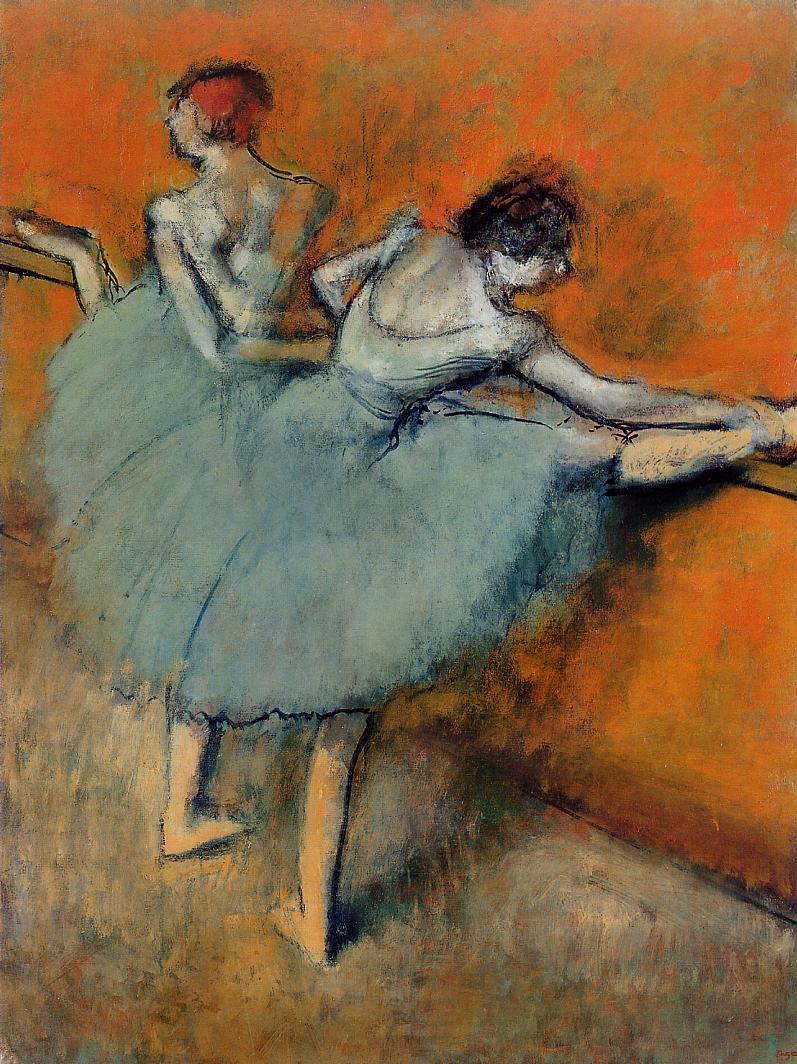
Degas’s intimate dancers

There are any number of reasons why Edgar Degas is a contender to be my favorite French Impressionist. For one thing, he was the most superb draftsman. Then there’s his subject matter, and the amount of time and talent he spent painting horses and ballet dancers – both exquisite creatures in their own ways. It was an absolute treat to see the exhibition at the Phillips Collection in DC this weekend, Degas’s Dancers at the Barre: Point and Counterpoint. The centerpiece is the Phillips painting called Dancers at the Barre and an earlier sketch for the work.

There are many reiterations of his different paintings throughout the exhibition, and that makes an interesting parallel with ballet itself, which relies so much on the discipline of revision and repetition. There’s also a comment posted by the writer Paul Valery, who said that Degas was like a writer in the way he was constantly honing his work and making revisions. Degas often painted the sometimes seedy and unglamorous side of ballet from that era, and yet he was so loving in the intimate way he showed the bodies – the collar bones, the curve of a shoulder, the spine like a string of pearls, the child-like hollow at the back of the neck. It’s wonderful to get lost in that world.

Of course, no visit to the Phillips is complete without a visit to the prize of the collection, Renoir’s Luncheon of the Boating Party. And then you’re back to square one, trying to decide who your favorite French Impressionist is.