
Concert Opera Baltimore continues its season at the Engineer’s Club with Verdi’s middle period masterpiece Rigoletto on November 18th and 20th. Managing Director, Courtney Kalbacker, came in to talk about that and more.


Maryland's All-Classical Music Station
Concert Opera Baltimore continues its season at the Engineer’s Club with Verdi’s middle period masterpiece Rigoletto on November 18th and 20th. Managing Director, Courtney Kalbacker, came in to talk about that and more.
OPERA: Macbeth
COMPOSER: Giuseppe Verdi
LIBRETTO: Francesco Maria Piave
The Chicago Symphony Orchestra is excited to share this performance of Verdi’s Macbeth, recorded in Chicago in 2013 to celebrate the 200th anniversary of Verdi’s birth. Music Director Riccardo Muti, one of the finest living Verdi interpreters, led the dynamic and moving concert with a cast featuring Luca Salsi (Macbeth), Tatiana Serjan (Lady Macbeth), Dmitriy Belosselskiy (Banco), and Francesco Meli (Macduff). The combined forces of the CSO, the Chicago Symphony Chorus (Duain Wolfe, director), and Riccardo Muti make this a program not to be missed.
Critics were unanimous in praising the all performers, with the Chicago Sun-Times declaring, “From her first aria, thrilled by news of Macbeth’s victory in battle, Serjan’s lady was a woman possessed. Combining hellish fire and deadly ice, she soared fearlessly through Verdi’s punishing coloratura flights but also brought subtle color to his long, singing lines.” The Chicago Tribune stated, “Together with the splendid Chicago Symphony Chorus and a virtuoso orchestra that made up in power and precision what it lacks in operatic playing experience, Muti led a finely detailed, dramatically gripping account that kept one focused on the inexorable unfolding of a great Shakespearean tragedy, retold through Verdi’s great music. The audience leapt to its feet at the end of the nearly 31/2-hour performance (including two intermissions), applauding and cheering into the night.”
CAST:
Macbeth: Luca Salsi
Lady Macbeth: Tatiana Serjan
Banquo: Dmitriy Belosselskiy
Macduff: Francesco Meli
Malcolm: Antonello Ceron
Lady-in-Waiting: Simge Büyükedes
Assassin/Doctor: Gianluca Buratto
Servant/Herald: Daniel Eifert
Three Apparitions:
David Govertsen
Katelyn Casey
Lily Shorney
CONDUCTOR: Riccardo Muti
ORCHESTRA: Chicago Symphony Orchestra
CHORUS: Chicago Symphony Chorus
CHORUS MASTER: Duain Wolfe
Approx. Length: 3 ½ hours
Today is the bicentennial of Giuseppe Verdi’s birth, and this weekend, The Columbia Orchestra will celebrate with two performances of his dramatic, operatic Requiem. They’ll be joined by Choralis and guest soloists; you can click on the link below to hear my chat with The Columbia Orchestra’s Music Director, Jason Love.
When we spoke the other day, I had no idea that Maestro Love was recently awarded The American Prize in Orchestral Programming – Vytautas Marijosius Memorial Award. Please click on this link to The American Prize blog if you’d like more information. Congratulations, Maestro!
I’m sure you are aware by now that 2013 is the 200th anniversary of Verdi’s birth, and we are bound to hear even more Verdi operas than usual. Washington Concert Opera is taking an interesting slant by opening their 2013-2014 season with two little known operas by the great man. On Sunday, they launch their season with I Masnadieri (The Bandits). Tenor, Rolando Sanz, came in to talk about it.

Judith recently had a wonderful fangirl moment with Emanuel Ax; now it’s my turn. For some years, I’ve been a devotee of Dmitri Hvorostovsky’s singing. Jim and I have seen him perform operatic roles, song cycles, and recitals, all brilliantly. I had the chance to interview “Dima” in 2002 when he was in town to sing Mussorgsky’s Songs and Dances of Death with the Baltimore Symphony Orchestra. Needless to say, I jumped at the opportunity, only to find that when he actually arrived at WBJC’s old studios, I was almost unable to speak in his presence, let alone ask intelligent questions. Fortunately, Hvorostovsky couldn’t possibly have been more gracious, and through the miracle of digital editing, I managed to create something airable out of our chat.
A few weeks ago, I discovered that due to Jim’s rehearsal schedule for Chess and his gig running surtitles for Annapolis Opera’s Rigoletto, I was about to have most of a March weekend all to myself. What to do? Wait – Dmitri was singing Posa in Don Carlo at the Met? Never mind that Jim and I saw him perform the role in 2006; there’s no such thing as too much Dima. I quickly procured tickets for the opera and the Bolt Bus and was off to Manhattan, eager to see the performance, visit with friends, and perhaps have my picture taken with a certain baritone.
There was no guarantee that such a photo op would arise, of course, but with two friends who sing in the full-time Met chorus (and who just happened to be in this production) I was hopeful. Upon my arrival in New York, I dropped my suitcase off with one of my friends, who was about to go onstage in the Met’s matinee of Francesca da Rimini, but had kindly agreed to stash my bag in the dressing room so that I could go museum-hopping and shopping unencumbered.
Fast-forward through my afternoon wanderings and dinner with friends, although both were lovely. How was the opera, and did I get a pic with Dmitri? Fabulous, and…

Indeed I did! Despite the fact that the opera ended well after midnight, Dmitri was kind enough to pose with me. It’s most unfair that he looks great after singing such a lengthy opera, while I appear… well… bedraggled, but unlike myself, he probably had the sense not to walk around getting snowed on all afternoon. We had a brief visit, during which I asked if he remembered our 2002 interview; alas, he didn’t, but he said very nice things about my voice. (Wait – I got a compliment on my voice from Dmitri Hovorostovsky?) Even though it was in regard to speaking, not singing, I was over the moon.
Have you met one of your favorite performers, and if so, do you have photographic evidence? Feel free to post stories and pics here!
Last Saturday, I attended the Metropolitan Opera’s HD broadcast of Rigoletto at the Charles Theater. I was delighted to see that there wasn’t an empty seat in the room and the audience demographic ranged from high school to retirement age. As a fan of Rat Pack-era design, I was pretty excited about seeing this production, which is set in early 1960’s Las Vegas, and it not only met my expectations, it exceeded them.
The cast is fabulous, both vocally and theatrically. Piotr Beczala is so suave and charming as the Duke that one could easily see why all of the women in Mantua – er, Vegas – would fall for him. Diana Damrau is lovely as the pure, innocent Gilda, who longs to be a good daughter to her father, yet also wishes to be loved as a woman. Zelko Lucic’s Rigoletto is tragic, yet never pathetic, even when his desire for revenge leads to disaster.
Some theater-goers aren’t fans of “concept” productions – stagings that remove a piece from its original setting and/or historical context. I think they can be great as long as the concept is well thought out and has something to do with the plot and characters of the show. That said, I very much dislike the fact that some critics seem to believe updating certain theatrical genres (usually opera or Shakespeare) should practically be mandatory. When a review dismisses a production merely for being “traditional”, I roll my eyes.
The Met’s Rat Pack Rigoletto succeeds because it’s as strong musically as it is theatrically; as such, the drastic change of setting and period seems daring rather than gimmicky. Visually, it’s a stunningly beautiful show. Many members of the production staff, notably stage director Michael Mayer, set designer Christine Jones, and costumer Susan Hilferty, have considerable experience working on Broadway, yet the flashy staging doesn’t take away from Verdi’s music for a moment. Rigoletto runs through May 1 at the Met, but just two performances featuring the aforementioned cast remain.
Here’s Piotr Beczala singing Questa o Quella in Act 1 of Rigoletto.

Conductor: Manfred Honeck
Soprano: Angela Meade
Mezzo-soprano: Marina Prudenskaja
Tenor: Dimitri Pittas
Bass: Liang Li
Mendelssohn Choir of Pittsburgh
Chatham Baroque
VERDI: Requiem
Fill:
Monteverdi: “Sanctorum Meritis”
Schmelzer: “Lamento Sopra La Morte”
While skimming friends’ Facebook posts this morning, I came across a few comments relating to Placido Domingo & Stephen Colbert having sung Verdi’s La Donna e Mobile on last night’s “Colbert Report.” Having missed the broadcast, I immediately Googled the performance & was delighted with the video I found. Both men sound great & look as if they’re having a blast! Of course, I was well aware of Mr. Domingo’s musical credentials, but not of Mr. Colbert’s. Turns out he majored in theater at Northwestern University & originally intended to perform on the stage, not the small screen. He also performed in Stephen Sondheim’s “Company” at Lincoln Center last year – at the composer’s invitation! You can read more about that adventure here: http://www.npr.org/2011/06/14/137109384/stephen-colbert-in-good-company-on-broadway
I’ve posted before about all of the hand-wringing in the opera biz re: the future of the art form & am sure I will do so again. It’s not unjustified, but I think perhaps it gets out of hand (or at least is handled poorly) on occasion. Judging from the studio audience’s reaction to Mr. Domingo’s & Mr. Colbert’s performance, opera isn’t dead yet. If pop culture audiences were exposed to more opera, would they actually buy tickets to live performances? Hmm.
Speaking of opera in a pop culture venue, Jonathan Palevsky & I will be at the Charles Theater tomorrow to welcome the audience for the Met’s Live in HD broadcast of Verdi’s “Ernani.” Showtime is 12:55 pm; hope to see you there!
To see the video of “La Donna e Mobile”, visit www.colbertnation.com

Back in November, Jim & I were lucky enough to catch a revival screening of Luchino Visconti’s 1963 film “The Leopard” at the Charles. Since I occasionally play excerpts from the film’s soundtrack (fabulous work by Nino Rota, with a little help from Verdi) on WBJC & am a longtime fan of old movies, I’d wanted to see it for years. Jim & I have pretty similar taste in cinema, so he didn’t balk at the thought of spending a good chunk of a Saturday watching a very long movie that’s nearly five decades old.
The print we saw was stunningly gorgeous – Martin Scorsese & Gucci were instrumental in the film’s recent restoration – but good looks alone won’t save a three-hour movie from being a bore if it’s dated. Fortunately, “The Leopard” has held up very well over the decades in terms of script, acting, direction, & visuals – with regard to the latter, the attention to period detail is so remarkable that the film seems to consist of a series of 19th-century paintings come to life. Between the two of us, Jim & I know a bit about history, architecture, & fashion, & neither noted any glaring anachronisms – a rare occurrence! The story is well-paced & the script, in which director Visconti had a hand, is very moving, but also quite witty at times.
“The Leopard” is based on Giuseppe Tomasi de Lampedusa’s novel of the same name. The film takes place in the early 1860’s, during the Risorgimento. Prince Don Fabrizio Salina, the main character, is concerned not only about political events, but also with his noble Sicilian family’s place in a rapidly changing world. I received a copy of the novel from my Secret Santa (thanks again, Steph!) & devoured it during the holidays – a great read, & I am pleased to say the film is very true to the novel, although I found the latter considerably more cynical. If you’re looking for an intelligent film or book to pass some time with on a cold winter’s night, I’d highly recommend both versions of “The Leopard.”
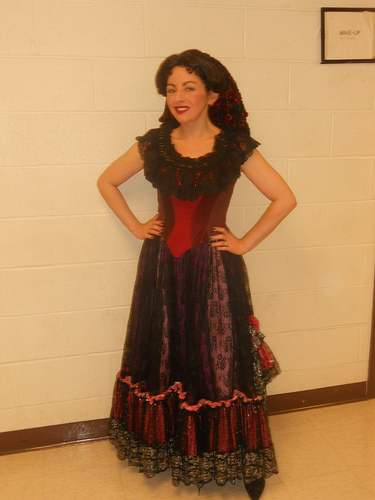 Baltimore, are you ready for some opera?
Lyric Opera Baltimore’s “La Traviata” opens tonight & I am as excited as a five-year-old on the night before Christmas. So many people have worked so hard to start this brand-new company, but in my opinion, the biggest kudos should go to the fabulous James Harp, LOB’s Artistic Director. Mr. Harp has put his heart & soul into this production, as always, & it shows.
There’s a great deal of concern in the classical music world – & especially among those of us who perform & produce opera – about the graying of audiences & the need to bring in younger ticket-holders. The internet is full of articles claiming that the operatic art form will die out sometime today if we don’t start doing all new rep, in modern dress, to bring in 20- & 30- somethings. Apparently period costumes, music by the likes of Verdi & Puccini, high ticket prices, & the common perception that opera is “elitist” are what’s keeping younger folks away.
I’m not so sure those points are valid, or at least that they’re all that’s turning people off on opera. A couple of weeks ago, my husband & I attended an excellent student production of Shakespeare’s “Macbeth” at Towson University. The incidental music was rather movie-score-esque & the fight scenes were a bit more intense than one sometimes sees, but otherwise, this was classic Shakespeare, in period dress. The house was packed & the vast majority of the audience was under 25. Not only were they extremely quiet & attentive (many theatergoers in my age group could have taken a lesson from them in that regard!), when the show was over, they applauded wildly, gave a most genuine standing ovation, & shouted for joy as if they’d just seen a rock concert. Shakespeare isn’t opera, you say? True, but the mostly-student audience at this week’s “La Traviata” dress rehearsal reacted in exactly the same way. I remember the young folks who came to final dress at Baltimore Opera being just as enthusiastic, & Mr. Harp loves to talk about the way kids who see his opera outreach performances react to the presentations – many say they want to be opera singers when they grow up!
As for the music, I will agree that operatic singing is a tough sell for some. During my days as a student announcer at WSUI/KSUI in Iowa City, Iowa, I had a colleague who was a punk rock fan (The Clash, etc.) & had only listened to opera on the air if he was board-opping for one of our broadcasts. He found the singing style off-putting & just didn’t understand what the big deal was. For some time, I urged him to attend one of the UI Opera Theater’s productions, & finally, he did. He came back to work the following Monday & said he’d had a blast! Even his misgivings about operatic singing had gone away. In his words: “I didn’t know one guy could do that with just his voice! No microphone! Nothing!” My colleague may not have become a hardcore opera fan, but his idea of the art form as stale & only for wealthy older folks (since this was a university production, there were quite a few students in the house) had changed, indeed.
I love hearing wonderful new music, but I certainly don’t think we need to shelve “La Traviata”, “La Boheme”, etc. Longtime opera fans may feel jaded about such repertoire, but we need to remember that most people haven’t heard or seen these shows multiple times, or even once. The music may have been written over a century ago, but it’s brand new to them. Also, like it or not, there is a segment of the opera audience that is not fond of newer music, & we need to present shows that will sell tickets in order to finance edgier fare. When I go to new operas or avant-garde productions of older works, my fellow audience members tend to be my colleagues… people who already love opera & just want something different tonight. Oh, & how about the fact that warhorses stick around for decades because they’re great works of art?
Grand opera is expensive to produce, & as such, it comes with high ticket prices. I’ll give the hand-wringers that. However, have you looked at ticket prices for a Broadway show, a Lady Gaga concert, or a professional sporting event lately? Yikes! If ticket prices are what’s keeping younger folks out of the opera house, perhaps it’s that they can afford to go to far fewer events these days, of any kind, & their favorites take priority. (Now, how do we go about making opera a “favorite?” Hmm.)
As for the perception of opera’s “elitism”, I would lay the blame for much of that squarely at the feet of popular culture. How many movies, TV shows, & commercials have you seen in which the bored husband is dragged to the opera (or ballet) by his socially ambitious wife & either falls asleep during the performance or spends the entire evening listening to a ballgame on headphones? I fume whenever I see such things.
While I certainly agree that we need to keep attracting new patrons, I don’t know that it’s realistic to expect them to be young folks, at least not entirely. Most people don’t embrace any form of classical music in their 20’s or 30’s. Concern that audiences are dying off has been rampant in the classical music world for at least 50 years – Leonard Bernstein’s “Young People’s Concerts” are but one example of attempts that have been made to reverse that trend, & guess what? If you remember when those concerts were on TV, you are now well over 50! I understand & share the concerns of those who are trying to make classical music, & especially opera, attractive to a new generation; I just don’t think we’re going about it in the best ways at this point. I will also freely admit that I don’t have all the answers, but I will keep my eyes & ears open, continue chatting with colleagues, & blog about such matters in the future. Please feel free to share your thoughts on this subject!
When I digress, I do it big-time, don’t I?