Home for the Holidays – and Potentially Missing Ten Million Dollars!

Baltimore actress Kay-Megan Washington has scored something most performers only dream about – a major role in a movie! “The Christmas Lottery” begins airing on BET, BET Her, and streaming services on December 12. Ms. Washington is a fabulous singer-actress and I recently spoke with her about her role as the family matriarch as well as what types of music bring her joy.


Topsy-Turvy Summer Fun at Young Vic

It’s probably no surprise to our listeners that all of WBJC’s announcers have off-air performing experience as singers, actors, or instrumentalists.With that in mind, I’m delighted to announce that our evening host, John T.K. Scherch, will be singing the title role in The Mikado at Young Victorian Theatre Company this summer. Earlier this week, I chatted with Music Director Chris Cicconi about the production.

Opera Goes to the Movies, 1935-Style

It’s less and less common to see classical music represented in popular culture these days, especially in a positive sense, so imagine my delight when I recently saw that Turner Classic Movies was airing Love Me Forever, a 1935 film starring Metropolitan Opera soprano Grace Moore. I’m rather ashamed to admit I didn’t know Moore’s work prior to seeing the film – I just happened to be browsing TCM’s broadcast schedule, noticed the words “opera singer” in the plot summary, and set my DVR to record.

gmlove_me_forever_filmposter

Moore was born in Mary Willie Grace Moore in Slabtown, Tennessee on December 5, 1898. She briefly studied music in Nashville before moving to Washington, D.C. and then to New York, where she got her first professional singing gig at the Black Cat Cafe in Greenwich Village. She performed in musicals and revues by Jerome Kern and Irving Berlin during the 1920’s, then moved to Paris to study opera. Moore made her Metropolitan Opera debut as Mimi in La Boheme on February 7, 1928. She must have made quite a hit as she went on to reprise the role at Covent Garden and sang sixteen seasons at The Met! Her repertoire featured French and Italian operas, notably the title role in Charpentier’s Louise, her favorite opera and considered by many her finest portrayal.

A number of opera singers were drawn to Hollywood after the advent of talking pictures, and Moore was among them. She made her screen debut in the 1930 film A Lady’s Morals, playing 19th-century soprano Jenny Lind.  Later that year, she co-starred with Met colleague Lawrence Tibbett in New Moon, a screen adaptation of The New Moon by Sigmund Romberg. Following a four-year hiatus from pictures, she played a small-town girl who aspires to be an opera singer in One Night of Love – art imitating life? – a role that garnered her an Academy Award nomination for Best Actress. Sadly, she was killed in a 1947 plane crash near Copenhagen’s airport when she was just 48 years old.

grace-moore

Love Me Forever is quintessential Depression-era entertainment in that it features characters who lose their fortunes, romance between people from vastly different backgrounds, class struggle, and visual escapism via absolutely stunning sets and costumes. Designer Robert Kalloch must have had a field day working on this project – the dress Moore wears when she sings Quando me’n vo’ in a nightclub is the epitome of opera costuming a la 1930’s Hollywood.

Moore plays society woman Margaret Howard, well-born but broke due to the Depression. Forced to auction off her personal belongings and family heirlooms, she avoids watching the sale, choosing to play the piano and sing in the room next door instead. Gangster Steve Correlli (wonderfully played by Leo Carrillo) and his right-hand man Luigi (Luis Alberni) are in attendance at the auction, intent on buying up the Howard family’s antiques. An avid music lover, Correlli hears Margaret’s voice and is instantly smitten. He gets her a job as a nightclub singer, then decides she’s meant to be an operatic soprano and opens a fancy nightclub as a showcase for her. Some bigwigs from the Met are persuaded to stop in at the club, they’re bowled over by Margaret’s performance, and suddenly, she’s hired to sing Mimi at the Met! (I’m sure my friends who are actively pursuing full-time opera careers would love a break like that.)

All doesn’t go smoothly, however – Steve has fallen in love with Margaret, but she’s announced her intention to marry Boston socialite Phillip Cameron (Robert Allan.) In despair, Steve continues to champion Margaret’s career, but drinks and gambles in an attempt to soothe his pain. Love Me Forever contains some opera-worthy plot twists and is a tale of love – not only the romantic sort, but of friendship – that’s well worth watching.

love-me-forever-movie-poster-1935-1020539191


In Stitches

Two years ago, I got into historical reenacting and docent work. I owned a lot of vintage clothing at the time – still do – but nothing remotely appropriate for Georgian or Regency events. I found a couple of gowns that will just barely pass muster for the latter period (they have zippers! Quel dommage!) on etsy and eBay, respectively, but a good quality 18th century-style dress isn’t so easy to come by unless one has about $500 lying around. Yikes! I borrowed a “working class” outfit for a couple of events, but it wasn’t exactly figure flattering (loose jacket over very full skirt on short woman… no. Just no.) So, I enlisted the help of a dear friend, spent about $100 on the red and white fabric, and made this outfit:

PeacockdressRLH

(“Peacock” dress, Silly Sisters petticoat, hat from Fort Frederick Market Fair, American Duchess shoes)

Okay, confession time: my friend did most of the work. I’m still not a pro, and when we began working on this gown, I couldn’t even thread a sewing machine. So, I did cutting, tracing, bits of hand sewing, trim attachment, pressing, and other not-too-skilled labor. My friend tried to teach me to use an antique treadle sewing machine, but we gave that up shortly due to our desire to remain friends and our need to finish the dress for an event. We made it, and we’re still speaking to each other.

And I caught the sewing bug, big-time.

I love clothes, especially vintage styles, but the “real thing” can be a bit pricey these days and sometimes has condition issues, a 24-inch waist, or both. I’m kind of surprised that I didn’t discover sewing earlier, but my mom wasn’t making a lot of clothes (except Halloween costumes) by the time I was growing up and Home Ec was sort of “uncool” when I was in high school. But last year, I began searching for vintage patterns online and was amazed at the number of them one can purchase, usually at reasonable prices. I also discovered Gretchen “Gertie” Hirsch’s wonderful blog and her very instructive sewing books, which come complete with lots of vintage-inspired patterns. My mom sent me her “extra” sewing machine – a Necchi 524FB from the late 80’s or early 90’s – and I was off to the races. Sort of.

The Necchi had some quirks – she’d been sitting around for over 20 years, for starters – and then there was the fact that I couldn’t sew a straight line despite the very clear markings near the machine’s feed dogs. Aargh. After my machine had been tweaked a bit, I did manage to make a wrap skirt using a 70’s pattern and really loudly patterned cotton fabric to hide my poor stitching skills. I also bought some wonderful (and expensive!) fabric with radios on it, started making it into a skirt using a newer pattern I’d been given, and discovered there was so much ease in the thing that it could nearly have gone around me twice. Since that disaster, I’ve learned to make a muslin of each project or at the very least measure the pattern pieces before cutting and do a pinned or basted fitting prior to sewing. I had to rip the whole thing apart, lost some fabric in the process, and started over using a 1950’s pattern I’d bought online. That one was still larger than the measurements on the envelope indicated, but at least the end result will be wearable. Here’s my “radio skirt” in her unfinished state:

radioskirtunfinishedradioskirtdetail

I also tried to make a nightgown without using a pattern last summer. If you’re a novice sewist, this is probably one of the silliest things you can attempt. “But the instructions I found online looked so simple…” No, no, no. Fortunately, I didn’t mess up that fabric too badly, and this spring, with the help of the Pencil Skirt pattern from Gertie’s New Book for Better Sewing, I came up with this:

Gertie rose skirt

It was only a matter of time before I’d want a vintage machine, no? The Necchi actually sews quite well now, but many older machines were built like little tanks and are still going strong. Plus, they’re often gorgeous.

CloseModel15

This beauty came out of an estate and was a recent Craigslist find. She’s a 1946 Singer Model 15, and aside from needing a little cleaning, oil, and grease, she’s good to go! I named her Elsa after Schiaparelli, one of my favorite designers.

sideSingerModel15

Eventually, I hope to have enough of my own creations in my closet to participate in events like “Me-Made-May”, in which sewists and other crafty types post pictures of their DIY outfits online each day in May. I’d also love to own another 18th century-style dress someday, but it will be a while before my skills hit that level, so perhaps I’ll save up for a Silly Sisters gown or bribe the friends who’ve been helping me in this process with lots of home-cooked meals. If any of you sew, I’d love to see pics of your work!

Model15

Revisiting Sugarman

Just after I returned from Africa last August, my writing professor at UB (Marion Winik, whose interview I posted here last week) sent me an email asking me if I had seen the film, “Searching for Sugar Man,” because of its strong South African connection. As I wrote in a blog back then, as soon as I heard “Sugar Man”, “I Wonder”, “The Establishment Blues”, “Inner City Blues” and all the other familiar tracks from Rodriguez’s album “Cold Fact,” I was instantly transported back to my student years in Cape Town when those songs were part of the mix, along with Simon and Garfunkel, Bob Dylan, Leonard Cohen, Don McLean and other icons from that era.

This time, when I was in Cape Town recently, I decided to try to find the CD store that plays such a prominent role in the movie. Judging by the shots of the mountain, I had been able to place that it was somewhere in the vicinity of the Gardens neighborhood and, using Devil’s Peak and Table Mountain as a guide, we drove up Long Street, parked and retraced our steps until the mountains were in the right perspective – and there, on Rheede Street we found Mabu Vinyl & Sugar Music.

I thought how curious that this shop should be on this particular street in Cape Town. It is very close to the drama school campus of the University of Cape Town, where I spent four highly charged years, and I walked this very road daily at various stages of my student life because I lived up a dogleg close by.

The lovely thing about Mabu Vinyl & Sugar Music is that they haven’t cashed in on the success of the Oscar winning documentary and commercialized the shop in any way. There is a little handmade sign to say that they sell Rodriquez’s CDs and the DVD of the documentary, but otherwise it is a grungy second hand book and LP store oozing character and nostalgia.

I could have bought “Cold Fact” on Amazon at any time, but I wanted to buy it there, and did. Now, as I drive around Baltimore, I am cheating on WBJC by playing the CD over and over, re-living my days in the Gardens in Cape Town.

DSCN1101


A gala event

Never mind Shakespeare’s play within a play in Hamlet, on Saturday night WBJC had a party within a party at the BSO’s Opening Gala. In a corner of the lavish tent adjacent to the Meyerhof, making a discreet rumpus, could be found Mark Malinowski wearing one of his signature bow ties and an unostentatious lapel pin of commendation from the Navy, Kati Harrison sporting a retro 60’s hairstyle and little black dress, Dyana Neal giving off an aura of the 50s in a flare-skirted lace dress and Cleopatraesque eye make up, and Word on Wine’s Mary Zajak dressed in shades of antique pink.  Over the din of the crowd we held animated and shouted conversations about martinis, writing, movies, libraries—oh, and music. During the dinner before the concert, and at the dessert reception afterwards, we rubbed shoulders with the likes of Senators Barbara Mikulski and Ben Cardin, Congressmen Dutch Ruppersberger and John Sarbanes, and Lieutenant Governor Anthony Brown (the Governor was notable by his absence), to say nothing of the Maestra and our beloved BSO players.  Then there was the centerpiece of the gala concert itself—the creamy-voiced “people’s diva”, Renée Fleming, in flowing gowns and teeter-inducing shoes, who treated us to arias by Lehár, Dvořák and Puccini, as well as songs by Rogers and Hammerstein. The BSO’s 2012-2013 season has kicked off in style!

BSO image of
Renée Fleming

The parting gift from the BSO was their forthcoming Naxos release of Mahler’s Symphony No. 1, so listen for that soon on WBJC.

What’s the difference between an amateur and a professional?

A paycheck. Okay, that may not work as a joke, but it’s food for thought for all of us who love creating art of any kind. Some may think I’m oversimplifying in making such a statement, & perhaps I am, but please allow me to explain.

The arts are in crisis these days. Over the past few years, many symphonies, opera companies, & other organizations have gone bankrupt or had to drastically reduce expenses. Many of my performer friends – especially those who used to rely on gigs for most or all of their income – are finding it harder & harder to pay the bills through their creative work. I’m sure visual artists are feeling the pinch as well. Yet we keep on singing, playing, acting, dancing, & painting,  sometimes doing for a stipend (or even gratis!) what we were once paid quite well to do. Why?

I think this quote sums it up quite nicely.


Of course, there are other distinctions that can be made between amateur & professional artists, including training, discipline, life choices, &, in some cases, talent. Throughout the course of my career, I’ve been fortunate enough to work with numerous amazing “amateur” actors & singers who have chosen other ways to pay the rent, but have  tons of talent & work ethics just as good as those of anyone I’ve encountered on a paid gig. What we all have in common is that the creative process fulfills us in ways nothing else can. When we’re lucky enough to be allowed to share that experience with an audience, it’s even better.


Sugarman

Noêl Coward has Elyot say in “Private Lives”, “It’s extraordinary how potent cheap music is.”  Well, I think most music is potent, cheap or not, and I was reminded of this all over again when I went to The Charles this weekend to see “Searching For Sugarman.”  My creative nonfiction professor alerted me to it because I have written a lot about Cape Town and living through apartheid in her classes, and this documentary is an incredibly moving account of how the music of the Detroit singer-songwriter, Rodriguez, which faded from memory in America, caught fire in South Africa during the apartheid years, igniting a quiet protest, and the more the authorities tried to ban it, the more iconic it became.  I must confess that all these years later I would not have been able to put a name to the artist, but as soon as I heard “Sugarman”, “I Wonder”, “The Establishment Blues”, “Inner City Blues” and all the other familiar tracks from the album “Cold Fact” I was instantly transported back to my student years in Cape Town, when those songs were part of the mix along with Simon and Garfunkel, Bob Dylan, Leonard Cohen, Don McLean and other icons from that era. This is a wonderful documentary, not only because of the music and the breathtaking scenes of Cape Town but also because of the way it captures the soul of the man.  An added connection is that one of the main protagonists, Craig Bartholomew-Strydom, now lives and works as a writer in Baltimore, Maryland. As I commented in my last blog post—small world.

http://www.sonyclassics.com/searchingforsugarman/site/

PBS poster

Une Voyageuse Fabuleux


The Charles Theater is presenting The Metropolitan Opera’s live HD broadcast of Massenet’s Manon tomorrow & I’ll be on hand to greet audience members, hand out “swag”, & enjoy the show. Not a bad way to spend a Saturday, right? It gets better. Sara Stewart, a wonderful, talented woman who’s a member of the Met’s regular chorus  – & a longtime friend of Jim’s & mine – has a solo in this opera.

We first met Sara during Young Victorian Theatre Company’s 2001 production of  H.M.S. Pinafore. If you saw that show, Sara was Josephine, I was Cousin Hebe, & Jim was The Handsome Dark-Haired Guy in the Chorus. Jim & I know a lot of extremely talented singers, but even so, Sara’s voice always impressed us. We’re all too aware that there are no guarantees in any business, especially in the arts, yet we (& many others) had a feeling she’d go on to do great things.

From 2002-2009, Sara & I sang in the Baltimore Opera Chorus together; she also had several small roles with the company during that time. In 2009, Baltimore Opera went bankrupt, which was devastating to everyone who’d worked there, both artistically & financially, but far more so to someone at Sara’s level.

In 2010, Sara announced that she’d auditioned for the regular chorus at the Metropolitan Opera… & that she’d gotten the job! To put this in perspective: if you’re a professional opera chorister, the Met is the best gig in the country. It’s the only company I know of at which such work pays enough to make a living – no office job, teaching, retail, or restaurant work required. Compensation aside, hello, it’s the Met.

Once a season, the Met, like other professional companies, has auditions for chorus members who wish to be considered for small roles. The character Sara is portraying in Manon is referred to simply as “Une Voyageuse” in the score, but Ms. Stewart, with the sense of humor I recall so well from our many productions together, has re-named her “La Voyageuse avec les Oiseaux Morts.” Apparently the props department has given her a birdcage to tote around the stage & its fine, feathered inhabitants are on their backs at the bottom of said cage. I do hope the “deceased” critters are clearly visible on the big screen tomorrow!

Singing in the Met Chorus is nice work if you can get it, true, but it’s also hard work, & the schedule can be somewhat erratic. One’s workload during a given week depends largely on casting. No chorus member sings in every show that happens in the season. Some operas have no chorus, others just men, others a smaller chorus. The small chorus operas get divided up among the regular choristers so that the work/pay is fairly close to even. Staging rehearsals typically begin at 10 or 10:30AM, with more music or staging work possible in the afternoon; the rehearsal day typically ends around 5PM. If a singer is in rehearsal for one show & simultaneously performing in another, which is not uncommon, they will need to be back at the theater around 7PM. The Met presents 7 performances a week, Monday through Friday and two on Saturday; there are usually four productions running concurrently. In Sara’s words, “Bottom line, it takes a master’s degree just to understand the schedule!”

Bravissima, Sara; we are so proud of you & can’t wait to catch your performance on the big screen tomorrow! For those who are planning to join us at The Charles, we’ll be there at 11AM; the opera begins at 12 Noon.

Breathing the same air

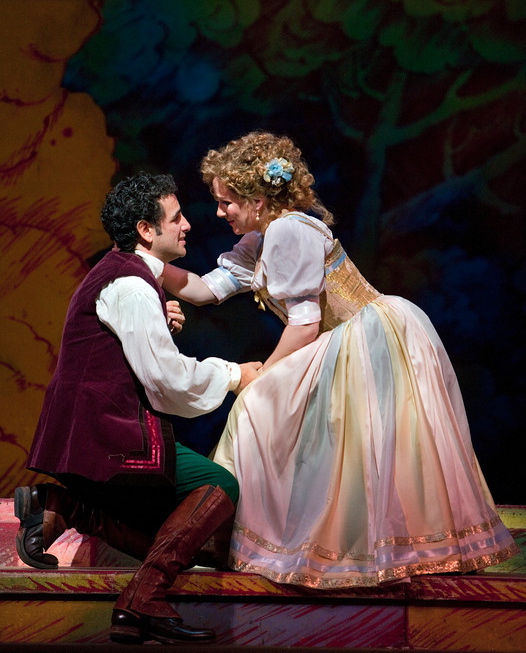
It was a first for me.  I have never before been to the opera when a singer gave an encore of an aria in the middle of the performance.  I guess it depends on the opera, and an opera buffa certainly lends itself to it more than, say, Wagner’s Ring Cycle!  Well, if you were listening to the opera broadcast on Saturday, you will know that it happened at The Metropolitan Opera, after the famous Act II tenor aria, “A furtive tear” from Donizetti’s “L’Elisir d’Amore”.  The playbill describes the aria this way, “…in Act II’s showstopping aria “Una furtiva lagrima,” it is much more than an excuse for a gorgeous melody: the aria’s variations between major and minor keys in the climaxes are one of the opera’s savviest depictions of dawning consciousness, as the hero simultaneously accepts the possibility of love and his own power of self-assertion.”

The first time I truly became aware of the Peruvian tenor, Juan Diego Flórez, was during a Great Performances broadcast on PBS with Gustavo Dudamel.  The wide ranging repertoire that Flórez sang in the concert included “Ah! Mes Amis!” from Donizetti’s “La Fille du Régiment”, complete with its nine high C’s, which he knocked off with great aplomb, as if it were no great achievement at all.  I determined then and there to hear him live, and when I saw that he was singing Nemorino in “L’Elisir d’Amore”, that was my chance.

It turns out he’s not only a fabulous bel canto tenor, with an exquisite, shimmering, quick vibrato, he’s also a lovely actor (he can even dance), and he captured all the disarming vulnerability of unrequited love with great charm and hilarity.  Then there was the Act II aria; just him alone on the stage with his suitcase, about to go off to enlist in the army.  It was utterly spell-binding, and you could have heard a pin drop in 4,000 capacity opera house.  Afterwards, the applause stopped the show, and he stepped out of character to take a bow.  Then there were cries on “Encore!” from the left side of the auditorium.  Flórez stepped forward, gestured to the conductor, and obliged—and the aria was even better than the perfect time before.

There was a funny moment then because the stage action had him picking up his suitcase, preparing to walk off towards stage left, stopping in his tracks, and back-tracking a few steps.  The audience took it as an indication that he would reprise the aria again!  After a couple of these false starts, he stepped out of character again and explained that Miss Damrau was waiting to come on, as indeed she did (also giving a superb performance), and the show could go on.  It was all so engaging and in keeping with the character of the whole production, somehow.

I think I am easily star struck.  I am always completely awed by excellence, and the sense of being in the same room as someone of the calibre of Juan Diego Flórez, breathing the same air, sharing the unfolding of events as they occur, is something I will never get used to or take for granted.  It is one of the great privileges of living in a country like this, where we have access to such excellence.

“Yay!” for the Met and its stellar singers and orchestra, and our chance to broadcast these performances on WBJC.