The Nightmare… and Unrequited Love

As I was running the operations shift for Reed Hessler’s Sunday show, I grabbed the CD case for Raff’s Symphony No 5. “Lenore” and saw the terrifying cover art.

717px-Johann_Heinrich_Füssli_053I was mesmerized by this creepy horse and flipped through the liner notes to see who had painted this. “The Nightmare” by Henry Fuseli.

What followed was me falling down (yet another) Wikipedia Hole…

Much like my favorite musical work (The Symphonie Fantastique), The Nightmare is inspired by unrequited love and a tortured soul. Fuseli had fallen in love with a friend’s daughter, and became obsessed with having her. She refused his marriage proposal, and instead married someone else. Many believe The Nightmare depicts Fuseli’s unresolved feelings for his lost love and his darkest desires.

This series of paintings that Fuseli produced have inspired everything from Mary Shelley to Edgar Allen Poe, poems to political satire.

“So on his Nightmare through the evening fog
Flits the squab Fiend o’er fen, and lake, and bog;
Seeks some love-wilder’d maid with sleep oppress’d,
Alights, and grinning sits upon her breast.” – Erasmus Darwin

I’m beginning to see a theme in my artistic tastes… I seem to be drawn to the dark, macabre yet beautiful worlds of insanity and unrequited love.

“If music be the food of love, play on,
Give me excess of it; that surfeiting,
The appetite may sicken, and so die.”
― William Shakespeare, Twelfth Night

In fact, I was just thinking of one of my favorite series of Waterhouse paintings as I sat at my loom the other afternoon based on the Lady of Shallott by Lord Alfred Tennyson, which is also about death at the hands of unrequited love.

659px-John_William_Waterhouse_-_I_am_half-sick_of_shadows,_said_the_lady_of_shalott“I Am Half Sick of Shadows,” Said the Lady of Shalott depicts a woman at her loom, who is cursed to live in a tower and unable to look upon the real world lest she die. She gets around this by viewing the world reflected in a mirror, and weaves what she sees into tapestry.

She’s upriver from Camelot, and sees Sir Lancelot coming and going quite a bit, and so falls madly in love with him. Unable to help herself one day, she looks out the window at him and invokes the curse.

Before she dies, she leaves her tower, climbs into a boat and her body floats down to Camelot. Lancelot looks upon her and remarks, “she has a lovely face”.

Well at least she didn’t have a incubus sitting on her chest.

And we come back to Raff’s Symphony No. 5 “Lenore”, which was inspired by a ballad of the same name by Wilhelm August Bürger. Raff wrote: “The happiness of two lovers is interrupted by war. The time has come when he must go forth with his fellow soldiers and she remain behind alone. In this solitude evil forebodings take possession of her; she falls into a fever, in which her hallucinations prepare, in reality, only for her own death.”

Bürger’s work features a lost love, blasphemy, a harrowing ride through demonic landscapes, Death Himself and themes of returning from the dead. Lenore is credited with partially inspiring the Gothic vampire genre.

So, thank you, whoever selected The Nightmare for the album cover art. You’ve helped me waste spend a delightful afternoon learning all about some cool and macabre fine art.

Stolen Renoir

The theft of seven paintings by  Picasso, Monet and others from the Kunsthal Museum in Holland recently is the last in a long line of heists from art museums. Back in 1951, this little Renoir called Landscape on the Banks of the Seine was stolen from the Baltimore Museum of Art.


BMA Director, Doreen Bolger, came in to talk to me about the mystery.

Stolen Renoir interview


On Painting And Popcorn

American artist Lennart Anderson will be giving a talk entitled “On Painting” at Johns Hopkins University’s Homewood Campus on Wednesday, October 10th at 5:30pm in the Arellano Theater, Levering Hall. I recently spoke with Craig Hankin, director of JHU’s Homewoood Art Workshops, about Anderson’s art, the influence of Degas, and Jiffy-Pop popcorn.

C. Hankin re: Lennart Anderson’s talk, “On Painting”

Oh, and I am old enough to be quite familiar with Jiffy-Pop.


What’s the difference between an amateur and a professional?

A paycheck. Okay, that may not work as a joke, but it’s food for thought for all of us who love creating art of any kind. Some may think I’m oversimplifying in making such a statement, & perhaps I am, but please allow me to explain.

The arts are in crisis these days. Over the past few years, many symphonies, opera companies, & other organizations have gone bankrupt or had to drastically reduce expenses. Many of my performer friends – especially those who used to rely on gigs for most or all of their income – are finding it harder & harder to pay the bills through their creative work. I’m sure visual artists are feeling the pinch as well. Yet we keep on singing, playing, acting, dancing, & painting,  sometimes doing for a stipend (or even gratis!) what we were once paid quite well to do. Why?

I think this quote sums it up quite nicely.


Of course, there are other distinctions that can be made between amateur & professional artists, including training, discipline, life choices, &, in some cases, talent. Throughout the course of my career, I’ve been fortunate enough to work with numerous amazing “amateur” actors & singers who have chosen other ways to pay the rent, but have  tons of talent & work ethics just as good as those of anyone I’ve encountered on a paid gig. What we all have in common is that the creative process fulfills us in ways nothing else can. When we’re lucky enough to be allowed to share that experience with an audience, it’s even better.


Uncorked: We’ll Drink To That!

“It warms the blood, adds luster to the eyes, and wine and love have ever been allies.” – Ovid

Jim & I love museums. We also enjoy wine, so when we learned that Winterthur was featuring an exhibition called “Uncorked! Wine, Objects, & Tradition”, we knew we’d have to pay a visit to Delaware. Our chance came last Saturday. Yes, we braved I-95N on a holiday weekend; hideous traffic notwithstanding, we had a great trip.

“Uncorked!” contains over 300 objects related to the history, making, &, of course, consumption of wine. Besides the obvious items (drinking vessels, storage & travel cases, etc.) there are song sheets, trade cards, artworks, & more on view. Some of the mezzotints & engravings are hilarious & quite bawdy – if you have delicate sensibilities, you’ve been warned! I loved the trick drinking vessels – decanters pierced in various spots or otherwise constructed so that one would have quite a time taking a swig out of them without spilling the contents. I’m sure these provided quite a bit of entertainment back in the day, especially when used by folks who had already been imbibing for a while. The show also includes “The New Game of Virtue Rewarded & Vice Punished” as well as other items related to the temperance movement & the potential ill-effects of wine.


One 19-century British music hall song referred to in “Uncorked!”, George Leybourne’s “Champagne Charlie”, was also hit in the U.S.  The song inspired a play based on Leybourne’s life – apparently he lived exactly the sort of decadent existence detailed in the lyrics. The play was even filmed in 1944.

Having seen “Uncorked!”, we wandered around Winterthur’s grounds for a bit – alas, it was too late at that point to visit other parts of the museum, but we’ve been before & most certainly will go back – then had a lovely Italian dinner. With Chianti, of course.

Degas’s intimate dancers

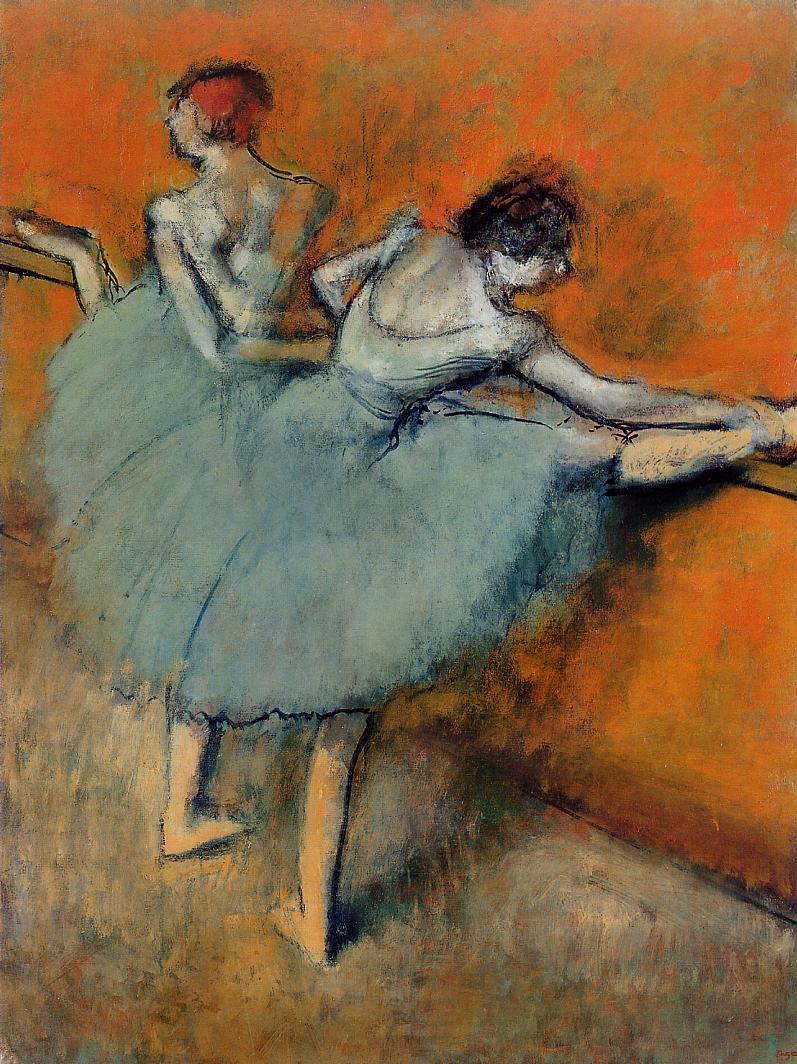
There are any number of reasons why Edgar Degas is a contender to be my favorite French Impressionist. For one thing, he was the most superb draftsman. Then there’s his subject matter, and the amount of time and talent he spent painting horses and ballet dancers – both exquisite creatures in their own ways. It was an absolute treat to see the exhibition at the Phillips Collection in DC this weekend, Degas’s Dancers at the Barre: Point and Counterpoint. The centerpiece is the Phillips painting called Dancers at the Barre and an earlier sketch for the work.

There are many reiterations of his different paintings throughout the exhibition, and that makes an interesting parallel with ballet itself, which relies so much on the discipline of revision and repetition. There’s also a comment posted by the writer Paul Valery, who said that Degas was like a writer in the way he was constantly honing his work and making revisions. Degas often painted the sometimes seedy and unglamorous side of ballet from that era, and yet he was so loving in the intimate way he showed the bodies – the collar bones, the curve of a shoulder, the spine like a string of pearls, the child-like hollow at the back of the neck. It’s wonderful to get lost in that world.

Of course, no visit to the Phillips is complete without a visit to the prize of the collection, Renoir’s Luncheon of the Boating Party. And then you’re back to square one, trying to decide who your favorite French Impressionist is.