

Une Voyageuse Fabuleux


The Charles Theater is presenting The Metropolitan Opera’s live HD broadcast of Massenet’s Manon tomorrow & I’ll be on hand to greet audience members, hand out “swag”, & enjoy the show. Not a bad way to spend a Saturday, right? It gets better. Sara Stewart, a wonderful, talented woman who’s a member of the Met’s regular chorus  – & a longtime friend of Jim’s & mine – has a solo in this opera.

We first met Sara during Young Victorian Theatre Company’s 2001 production of  H.M.S. Pinafore. If you saw that show, Sara was Josephine, I was Cousin Hebe, & Jim was The Handsome Dark-Haired Guy in the Chorus. Jim & I know a lot of extremely talented singers, but even so, Sara’s voice always impressed us. We’re all too aware that there are no guarantees in any business, especially in the arts, yet we (& many others) had a feeling she’d go on to do great things.

From 2002-2009, Sara & I sang in the Baltimore Opera Chorus together; she also had several small roles with the company during that time. In 2009, Baltimore Opera went bankrupt, which was devastating to everyone who’d worked there, both artistically & financially, but far more so to someone at Sara’s level.

In 2010, Sara announced that she’d auditioned for the regular chorus at the Metropolitan Opera… & that she’d gotten the job! To put this in perspective: if you’re a professional opera chorister, the Met is the best gig in the country. It’s the only company I know of at which such work pays enough to make a living – no office job, teaching, retail, or restaurant work required. Compensation aside, hello, it’s the Met.

Once a season, the Met, like other professional companies, has auditions for chorus members who wish to be considered for small roles. The character Sara is portraying in Manon is referred to simply as “Une Voyageuse” in the score, but Ms. Stewart, with the sense of humor I recall so well from our many productions together, has re-named her “La Voyageuse avec les Oiseaux Morts.” Apparently the props department has given her a birdcage to tote around the stage & its fine, feathered inhabitants are on their backs at the bottom of said cage. I do hope the “deceased” critters are clearly visible on the big screen tomorrow!

Singing in the Met Chorus is nice work if you can get it, true, but it’s also hard work, & the schedule can be somewhat erratic. One’s workload during a given week depends largely on casting. No chorus member sings in every show that happens in the season. Some operas have no chorus, others just men, others a smaller chorus. The small chorus operas get divided up among the regular choristers so that the work/pay is fairly close to even. Staging rehearsals typically begin at 10 or 10:30AM, with more music or staging work possible in the afternoon; the rehearsal day typically ends around 5PM. If a singer is in rehearsal for one show & simultaneously performing in another, which is not uncommon, they will need to be back at the theater around 7PM. The Met presents 7 performances a week, Monday through Friday and two on Saturday; there are usually four productions running concurrently. In Sara’s words, “Bottom line, it takes a master’s degree just to understand the schedule!”

Bravissima, Sara; we are so proud of you & can’t wait to catch your performance on the big screen tomorrow! For those who are planning to join us at The Charles, we’ll be there at 11AM; the opera begins at 12 Noon.
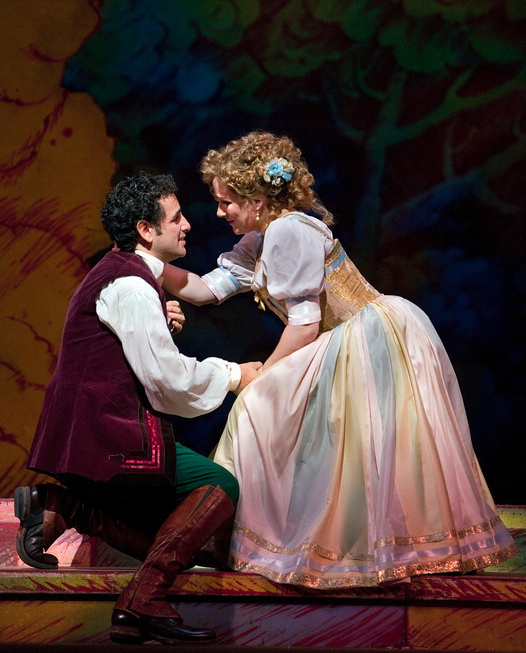
Breathing the same air

It was a first for me.  I have never before been to the opera when a singer gave an encore of an aria in the middle of the performance.  I guess it depends on the opera, and an opera buffa certainly lends itself to it more than, say, Wagner’s Ring Cycle!  Well, if you were listening to the opera broadcast on Saturday, you will know that it happened at The Metropolitan Opera, after the famous Act II tenor aria, “A furtive tear” from Donizetti’s “L’Elisir d’Amore”.  The playbill describes the aria this way, “…in Act II’s showstopping aria “Una furtiva lagrima,” it is much more than an excuse for a gorgeous melody: the aria’s variations between major and minor keys in the climaxes are one of the opera’s savviest depictions of dawning consciousness, as the hero simultaneously accepts the possibility of love and his own power of self-assertion.”

The first time I truly became aware of the Peruvian tenor, Juan Diego Flórez, was during a Great Performances broadcast on PBS with Gustavo Dudamel.  The wide ranging repertoire that Flórez sang in the concert included “Ah! Mes Amis!” from Donizetti’s “La Fille du Régiment”, complete with its nine high C’s, which he knocked off with great aplomb, as if it were no great achievement at all.  I determined then and there to hear him live, and when I saw that he was singing Nemorino in “L’Elisir d’Amore”, that was my chance.

It turns out he’s not only a fabulous bel canto tenor, with an exquisite, shimmering, quick vibrato, he’s also a lovely actor (he can even dance), and he captured all the disarming vulnerability of unrequited love with great charm and hilarity.  Then there was the Act II aria; just him alone on the stage with his suitcase, about to go off to enlist in the army.  It was utterly spell-binding, and you could have heard a pin drop in 4,000 capacity opera house.  Afterwards, the applause stopped the show, and he stepped out of character to take a bow.  Then there were cries on “Encore!” from the left side of the auditorium.  Flórez stepped forward, gestured to the conductor, and obliged—and the aria was even better than the perfect time before.

There was a funny moment then because the stage action had him picking up his suitcase, preparing to walk off towards stage left, stopping in his tracks, and back-tracking a few steps.  The audience took it as an indication that he would reprise the aria again!  After a couple of these false starts, he stepped out of character again and explained that Miss Damrau was waiting to come on, as indeed she did (also giving a superb performance), and the show could go on.  It was all so engaging and in keeping with the character of the whole production, somehow.

I think I am easily star struck.  I am always completely awed by excellence, and the sense of being in the same room as someone of the calibre of Juan Diego Flórez, breathing the same air, sharing the unfolding of events as they occur, is something I will never get used to or take for granted.  It is one of the great privileges of living in a country like this, where we have access to such excellence.

“Yay!” for the Met and its stellar singers and orchestra, and our chance to broadcast these performances on WBJC.

04/07/12 – Manon – 1:00pm

By Jules Massenet

Librettist: Henri Meilhac and Philippe Gille
Sung in French

Approximate running time 3 hrs. 55 min.

Anna Netrebko’s dazzling portrayal of the tragic heroine in Laurent Pelly’s new production travels to the Met from the Royal Opera House, Covent Garden. Piotr Beczala and Paulo Szot also star, with the Met’s Principal Conductor Fabio Luisi on the podium.

Cast

Conductor: Fabio Luisi
Manon: Anna Netrebko
des Grieux: Piotr Beczala
Lescaut: Paulo Szot
Comte des Grieux: David Pittsinger

The Production Team

Production: Laurent Pelly
Set Designer: Chantal Thomas
Costume Designer: Laurent Pelly
Lighting Designer: Joël Adam
Choreographer: Lionel Hoche
Dramaturg: Agathe Mélinand


03/31/12 – L’Elisir d’Amore – 1:00pm

By Gaetano Donizetti

Librettist: Felice Romani
Sung in Italian

Approximate running time 2 hrs. 35 min.

Donizetti’s melodic classic is well served by a quartet of bel canto stars: Juan Diego Flórez and Diana Damrau are the unlikely lovers, Mariusz Kwiecien the vainglorious sergeant, and Alessandro Corbelli the dispenser of the elixir.

Cast

Conductor: Donato Renzetti
Adina: Diana Damrau
Nemorino: Juan Diego Flórez
Belcore: Mariusz Kwiecien
Dulcamara: Alessandro Corbelli

The Production Team

Production: John Copley
Set & Costume Designer: Beni Montresor
Lighting Designer: Gil Wechsler


03/24/12 – Macbeth – 1:00pm

By Giuseppe Verdi

Librettist: Francesco Maria Piave and Andrea Mattei
Sung in Italian

Approximate running time 3 hrs. 0 min.

As the doomed couple, Thomas Hampson and Nadja Michael deliver the vocal fireworks of two of Verdi’s most challenging roles, Hampson for the first time at the Met and Michael in her company debut.

Cast

Conductor: Gianandrea Noseda
Lady Macbeth: Nadja Michael
Macduff: Dimitri Pittas
Macbeth: Thomas Hampson
Banquo: Gunther Groissböck

The Production Team

Production: Adrian Noble
Set & Costume Designer: Mark Thompson
Lighting Designer: Jean Kalman
Choreographer: Sue Lefton


03/17/12 – Khovanshchina – 1:00pm

By Modest Mussorgsky

Librettist: Modest Mussorgsky
Sung in Russian

Approximate running time 4 hrs. 10 min.

“Khovanshchina burns white-hot” (New York Times).

Mussorgsky’s sweeping epic, set during the reign of Peter the Great, is back on the Met stage for the first time in more than a decade, in a revival that is “blazingly sung, acted with conviction and conducted with intensity by Kirill Petrenko” (New York Times). “Olga Borodina’s performance as Marfa is a perfect match of voice and temperamentŠ riveting” (AP). The all-star Russian cast also includes Ildar Abdrazakov, Anatoli Kotscherga, George Gagnidze, Misha Didyk, and Vladimir Galouzine. “The chorus and orchestra turned in superhuman performances” (New York Post).

Cast

Conductor: Kirill Petrenko
Marfa: Olga Borodina
Andrei Khovansky: Misha Didyk
Vasily Golitsin: Vladimir Galouzine
Shaklovity: George Gagnidze
Ivan Khovansky: Anatoli Kotscherga
Dosifei: Ildar Abdrazakov

The Production Team

Production: August Everding
Set Designer: Ming Cho Lee
Costume Designer: John Conklin
Lighting Designer: Gil Wechsler
Choreographer: Benjamin Millepied


03/10/12 – Don Giovanni – 1:00pm

By Wolfgang Amadeus Mozart

Librettist: Lorenzo Da Ponte
Sung in Italian

Approximate running time 3 hrs. 25 min.

Michael Grandage’s elegant new production, which premiered last fall, is back with Gerald Finley in the title role and Andrew Davis on the podium. Kyle Ketelsen and Bryn Terfel share the role of Leporello, and the cast of refined Mozartians also includes Marina Rebeka, Ellie Dehn, Isabel Leonard, Matthew Polenzani, Shenyang, and James Morris.

Cast

Conductor: Andrew Davis
Donna Anna: Marina Rebeka
Donna Elvira: Ellie Dehn
Zerlina: Isabel Leonard
Don Ottavio: Matthew Polenzani
Don Giovanni: Gerald Finley
Leporello: Bryn Terfel
Masetto: Shenyang
The Commendatore: James Morris

The Production Team

Production: Michael Grandage
Set & Costume Designer: Christopher Oram
Lighting Designer: Paule Constable
Choreographer: Ben Wright


03/03/12 – Aida – 1:00pm

By Giuseppe Verdi

Librettist: Antonio Ghislanzoni
Sung in Italian

Approximate running time 3 hrs. 40 min.

Verdi’s vision of ancient Egypt is grandly realized with the help of the Met’s unparalleled musical forces—and every one of its stage elevators. Violeta Urmana and Marcello Giordani star as the ill-fated lovers. Stephanie Blythe sings Amneris for the first time at the Met.

Cast

Conductor: Marco Armiliato
Aida: Violeta Urmana
Amneris: Stephanie Blythe
Radamès: Marcello Giordani
Amonasro: Lado Ataneli
Ramfis: James Morris
The King: Jordan Bisch

The Production Team

Production: Sonja Frisell
Set Designer: Gianni Quaranta
Costume Designer: Dada Saligeri
Lighting Designer: Gil Wechsler
Choreographer: Alexei Ratmansky


Opera on-screen!

While skimming friends’ Facebook posts this morning, I came across a few comments relating to Placido Domingo & Stephen Colbert having sung Verdi’s La Donna e Mobile on last night’s “Colbert Report.” Having missed the broadcast, I immediately Googled the performance & was delighted with the video I found. Both men sound great & look as if they’re having a blast! Of course, I was well aware of Mr. Domingo’s musical credentials,  but not of Mr. Colbert’s. Turns out he majored in theater at Northwestern University & originally intended to perform on the stage, not the small screen. He also performed in Stephen Sondheim’s “Company” at Lincoln Center last year – at the composer’s invitation! You can read more about that adventure here:   http://www.npr.org/2011/06/14/137109384/stephen-colbert-in-good-company-on-broadway

I’ve posted before about all of the hand-wringing in the opera biz re: the future of the art form & am sure I will do so again. It’s not unjustified, but I think perhaps it gets out of hand (or at least is handled poorly) on occasion. Judging from the studio audience’s reaction to Mr. Domingo’s & Mr. Colbert’s performance,  opera isn’t dead yet. If pop culture audiences were exposed to more opera, would they actually buy tickets to live performances? Hmm.

Speaking of opera in a pop culture venue, Jonathan Palevsky & I will be at the Charles Theater tomorrow to welcome the audience for the Met’s Live in HD broadcast of Verdi’s “Ernani.” Showtime is 12:55 pm; hope to see you there!

To see the video of “La Donna e Mobile”, visit www.colbertnation.com


Adventures of a Mezzo in Manhattan

Greetings! It’s great to be back on the air. Jim & I took a trip to New York over the weekend, mostly to see Verdi’s Ernani at the Metropolitan Opera. We also got to visit with several friends, one of whom sings in the Met chorus (local opera fans may remember her: Sara Stewart, soprano extraordinaire.) Dating from 1844, Ernani is early Verdi  – the 5th of his 28 operas, to be exact – & is based on Victor Hugo’s drama Hernani, ou L’Honneur Castillan.  The opera anticipates Il Trovatore  not only in terms of plot (historic setting, doomed lovers, etc.) but also in its energetic melodies. Of course, Verdi’s writing for the voice was always exquisite; to my mind, the musical highlight of this performance was Dmitri Hvorostovsky’s stunning rendition of the Act 3 cavatina, Oh, di verd’anni miei (“Oh, the dreams & deceits of my youth.”) Overall, however, the strongest performance of the evening came from Ferruccio Furlanetto as Don Ruy Gomez de Silva, an aging Spanish grandee. Silva isn’t the most sympathetic character – among other things, he’s plotting a forced marriage to his niece, Elvira – but Furlanetto’s marvelous voice & top-notch acting kept him from turning into a cartoon villain, even for a second. So much for that old saw about opera singers not being able to act!

There were at least seven movie cameras in the theater that night, but the performance wasn’t being filmed; it was a dry run for this coming Saturday’s live HD broadcast of the matinee, which you can view locally at the Charles Theater. If you prefer to stay home & listen,  of course you may do so on WBJC-FM; the broadcast will begin at 1:00. Having worked on a few film & TV sets in my time, I’m always intrigued by the technical side of such work, & it was great fun to watch the three cameras at the front of the house (one boom-mounted on either side of the stage, one running along the footlights) moving about in a most unobtrusive fashion.

Delightful as it is, one cannot live by opera alone. Aside from our evening at the Met, last weekend’s Manhattan visit included a great deal of wonderful food & wine (& lots of running & walking to mitigate the effects of same!) We indulged in Italian fare at I Coppi & Eataly, Middle Eastern cuisine at Shalal, bought decadent sweets at Maison du Chocolat, & had my favorite savory breakfast – two days in a row! – at Bagel Boss. Shopping-wise, we visited a couple of our favorite vintage & resale haunts (La Boutique & the Garage Flea Market) & discovered a new one, Cobblestones, very near I Coppi. Apparently there’s a new Coen brothers movie being shot on the Lower East Side; we had to do a bit of negotiating with their film crew to get from the shop to dinner. I’ve no idea what the film is about, but it seems to be a period piece; there were antique cars from various eras parked along 9th Street last Friday evening & we spotted an actor in mid-20th-century clothing hanging around, waiting for his next call. By Sunday evening, when we boarded the train to come home, we were low on funds, exhausted, & already thinking about our next visit to the city.